

April Is National Heartworm Awareness Month
You know what’s frustrating? I can’t tell you how many times I’ve had this conversation:
“Dr. Steve, do we really need to do heartworm prevention year-round? It seems like a lot.”
And I get it. It’s another monthly expense. Another thing to remember. But here’s what I need you to understand – we live in South Florida. Our mosquitoes don’t take a winter break. They don’t hibernate. They’re out there right now, and all it takes is one bite from one infected mosquito to give your dog or cat a disease that can kill them.
April is National Heartworm Awareness Month, and I want to walk you through exactly what heartworm disease is, why it’s such a big deal here in Palm Beach County, what prevention looks like, and why spending a few dollars a month now could save you thousands later – not to mention your pet’s life.
What Exactly Is Heartworm Disease?
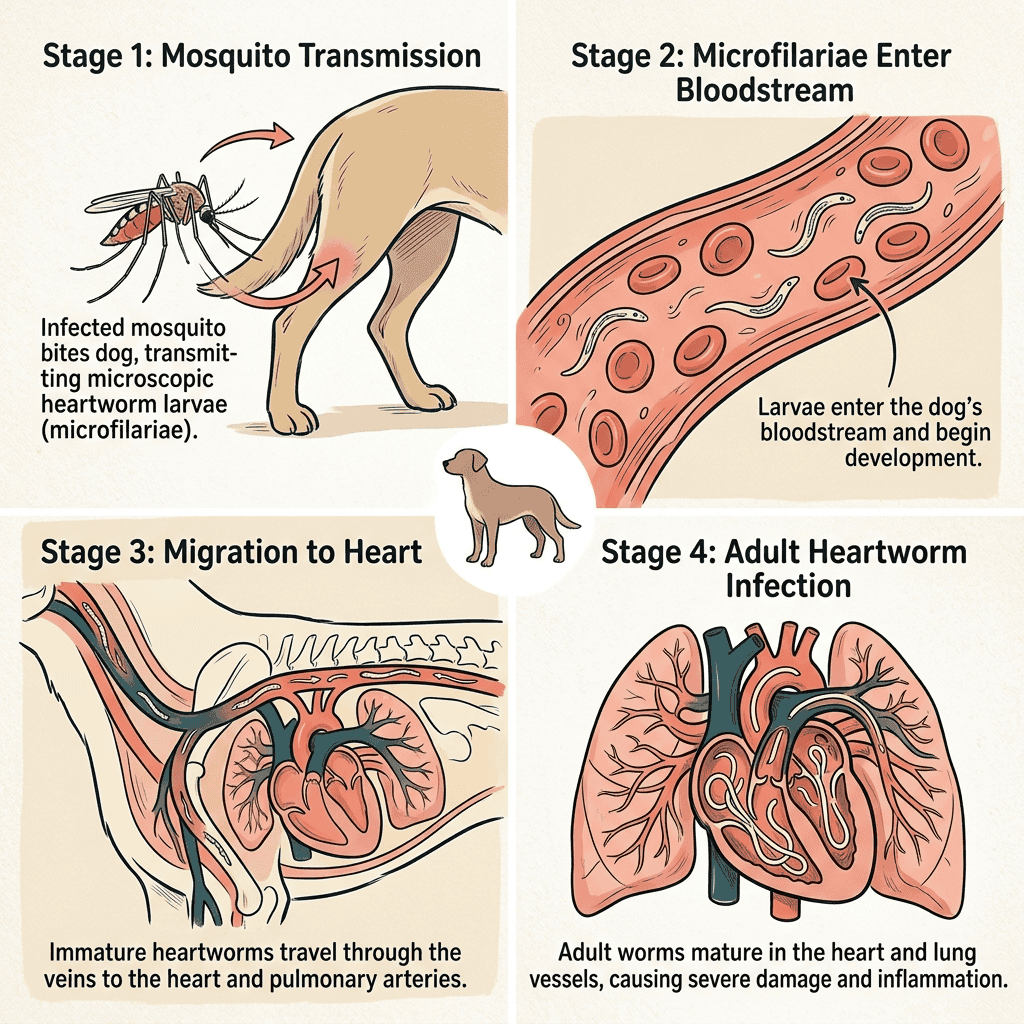
Let me break this down in plain English.
Heartworm disease is caused by a parasitic worm called Dirofilaria immitis. These worms are spread through mosquito bites – that’s the only way your pet can get them. Not from other dogs, not from the park, not from the water bowl. Mosquitoes. That’s it.
Here’s what happens: An infected mosquito bites your dog or cat. It deposits microscopic heartworm larvae into the bloodstream. Those larvae travel through the body and eventually set up shop in the heart, lungs, and surrounding blood vessels. Over the next several months, they grow into adult worms.
And when I say worms, I’m not talking about something tiny. Adult heartworms can grow up to 12 inches long. In your pet’s heart. Imagine that for a second.
Once they’re in there, they cause serious damage to the heart, lungs, and blood vessels. Left untreated, heartworm disease leads to heart failure, severe lung disease, organ damage, and death.
How Long Does This Take?
From the time your pet gets bitten to when adult worms are present, it takes about 6 to 7 months. And here’s the tricky part – during most of that time, your pet looks completely normal. No symptoms. No warning signs. By the time you notice something’s wrong, the damage is already happening.
That’s why we call it a silent killer. By the time your dog starts coughing, getting tired easily, or losing their appetite, we’re already dealing with a serious problem.
Why Palm Beach County Is Heartworm Territory

I’m going to be blunt about this. If you live anywhere in South Florida, your pet is at risk for heartworm. Period.
Florida is consistently ranked among the highest-risk states for heartworm disease in the country. The American Heartworm Society’s incidence maps show Florida as one of the states with expanding high-density heartworm areas. And it makes sense when you think about it – we’ve got the perfect storm:
Year-round mosquito activity. Unlike states up north where winter kills off mosquito populations, our mosquitoes are active 365 days a year. That means your pet is at risk every single day – not just in “mosquito season.”
Warm, humid climate. Palm Beach County’s tropical weather is paradise for mosquitoes. Between the Intracoastal, the canals, the retention ponds in every development, and the afternoon rain we get all summer – mosquitoes breed like crazy here.
Wildlife reservoirs. Heartworm doesn’t just live in dogs. Coyotes, foxes, and other wild animals carry it too. And when those mosquitoes bite an infected coyote and then bite your dog? That’s the cycle.
High pet density. We’ve got a lot of dogs in this county. The more untreated dogs there are, the more infected mosquitoes there are, and the higher the risk for everyone.
Here’s something that surprises a lot of people: even indoor cats are at risk. Studies have shown that a significant percentage of cats diagnosed with heartworm disease were described as indoor-only cats. Mosquitoes get inside. It only takes one.
The Warning Signs (And Why You Might Miss Them)

Heartworm disease progresses through stages, and early on, there may be no symptoms at all. That’s what makes annual testing so important – you can’t rely on symptoms to catch this.
Early signs (easy to miss):
- Occasional mild cough
- Getting tired a little faster than usual on walks
- Slight decrease in appetite
As it progresses:
- Persistent cough
- Reluctance to exercise or play
- Fatigue after moderate activity
- Weight loss
- Decreased appetite
Advanced disease:
- Difficulty breathing
- Swollen belly (from fluid accumulation)
- Pale gums
- Dark or bloody urine
- Heart failure
In cats, it can look different:
- Coughing or asthma-like attacks
- Vomiting (not related to eating)
- Decreased appetite
- Weight loss
- In some cases, sudden collapse or death with no prior warning
You know your pet. If something seems off – even if it’s subtle – bring it up at your next visit. Or call us. That’s what we’re here for.
Prevention: The Easy Part
Here’s the good news. Heartworm disease is almost 100% preventable. The American Heartworm Society says it, the AVMA says it, and I’ve seen it firsthand over 30 years of practice. Pets on consistent, year-round prevention essentially don’t get heartworm disease.
What Does Prevention Look Like?
Heartworm prevention medication is a prescription – you need it from your vet. This isn’t something you can pick up at the pet store without a veterinary relationship, and there’s a good reason for that. Your pet needs to be tested before starting prevention, because giving prevention to a pet that already has heartworms can cause serious complications.
There are several forms of prevention available:
Monthly Chewable Tablets – This is what most of our clients use. Brands like Heartgard, Simparica Trio, and Nexgard Plus are popular options. Your pet eats a flavored chewable once a month. Most dogs think it’s a treat.
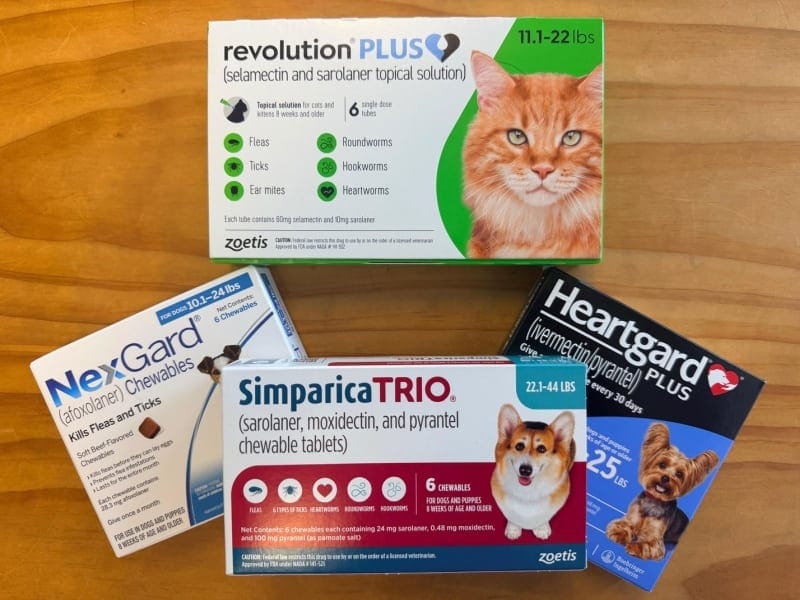
Topical (Liquid) Preventatives – Applied to the skin between the shoulder blades once a month. Good option for dogs who are picky eaters or have sensitive stomachs.
Injectable Prevention – An injection given by your veterinarian that provides protection for 6 or 12 months, depending on the product. Great for pet owners who have trouble remembering the monthly dose.
Which one is right for your pet? That depends on their age, weight, health status, and lifestyle. Some of these products also cover fleas, ticks, and intestinal parasites – so you might be getting multi-protection in one dose. That’s something we’ll talk about during your appointment and recommend what makes the most sense for your specific pet.
The Cost Comparison That Should Make This Decision Easy
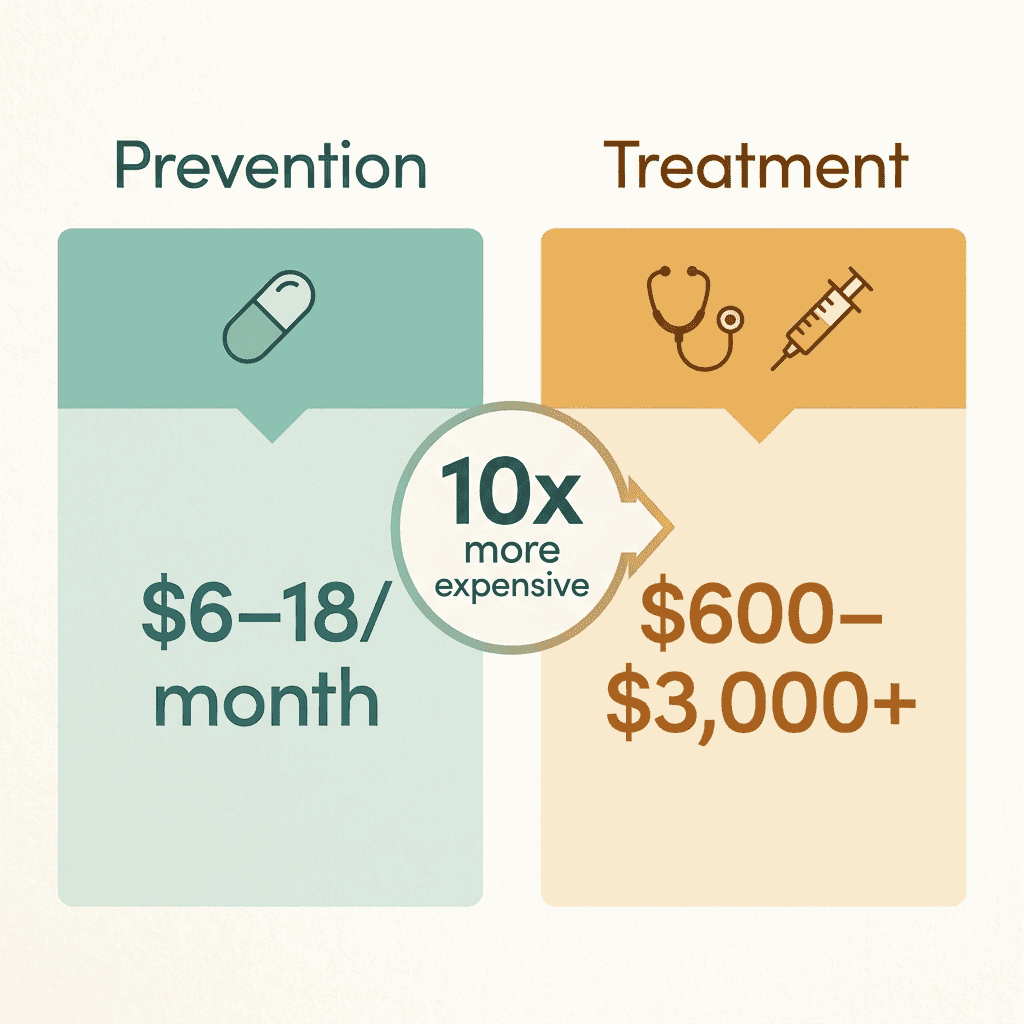
Let me put this in perspective:
Prevention: Typically starts around $9 to $38 per month, depending on your pet’s size and the product we recommend. That’s roughly $110 to $450 per year.
Treatment: If your dog gets heartworm disease, you’re looking at $600 to $3,000 or more. That includes the diagnostic testing, months of medication, multiple rounds of injections to kill the adult worms, and strict exercise restriction for months. And that’s assuming no complications.
Treatment costs roughly 10 times more than a full year of prevention.
And here’s what the money doesn’t cover: the stress on your pet. Heartworm treatment is hard on dogs. The medication used to kill adult worms (melarsomine) is an arsenic-based compound that has to be injected deep into the muscles of the back. Your dog has to be on strict crate rest for weeks because as the worms die, fragments can lodge in the lungs. It’s risky, it’s painful, and it takes months.
For cats, it’s even worse. There is no approved treatment for heartworm disease in cats. None. All we can do is manage symptoms and hope the cat outlives the worms. Prevention is literally the only option.
Prevention is easier, cheaper, and keeps your pet from ever going through any of that. Pretty straightforward choice.
Annual Testing: Why We Recommend It Every Year
Even if your pet is on year-round prevention, we recommend annual heartworm testing. I know that might seem redundant, but here’s why:
No prevention is 100% perfect. If a dose was spit out, vomited up, or not fully absorbed, there could be a gap in protection you didn’t know about.
It confirms the prevention is working. Think of it like checking your smoke detector batteries. You hope you never need it, but you want to know it’s working.
Early detection matters. If we catch it early, the treatment is more straightforward and the chances of a full recovery are much better.
It’s required before prescribing prevention. If your pet hasn’t been tested recently, we need to verify they’re heartworm-negative before starting or continuing preventive medication.
We do heartworm testing right during your regular wellness visit – it’s a simple blood draw. Quick, easy, and one less thing to worry about.
Common Questions I Get About Heartworm
“My dog is mostly indoors. Do they really need prevention?”
Yes. Mosquitoes come inside. Through open doors, through screens, through the garage. One bite. That’s all it takes.
“We just moved here from up north. Is this really that different?”
It is. In Palm Beach County, mosquitoes are active year-round. If you were doing seasonal prevention up north, you need to switch to year-round down here. Today.
“Can I just buy prevention online without a prescription?”
Heartworm prevention is a prescription medication. If you’re seeing it sold without requiring a prescription, that’s a red flag. Your pet needs to be tested first, and the right product and dose need to be determined by a veterinarian.
“My cat doesn’t go outside. They can’t get heartworm, right?”
Wrong. Indoor cats get heartworm. Mosquitoes get indoors. And remember – there’s no treatment for cats. Prevention is the only protection.
“What if I missed a couple months of prevention?”
Call us. Seriously. We need to discuss testing your pet before restarting, because if they were infected during that gap, giving prevention to a heartworm-positive pet can cause dangerous reactions. Don’t just restart on your own.
“Is heartworm disease contagious between my pets?”
No. Heartworm can only be transmitted through mosquito bites. But if one of your pets has heartworm, that means infected mosquitoes are in your area – which puts all of your pets at risk.
What to Do Right Now
Here’s my straightforward advice:
If your pet is on prevention: Great. Keep going. Don’t skip months. Make sure you’re current on annual testing.
If your pet is NOT on prevention: Call us today. We’ll test your pet and get them started on the right product. Every day without prevention is a day they’re unprotected.
If you’ve missed doses: Don’t panic, but don’t wait either. Call us at (561) 493-3860 so we can figure out the best next steps.
If you’re new to the area: Welcome to Palm Beach County. Year-round heartworm prevention isn’t optional here. Let’s get your pet set up.
Schedule Your Heartworm Test & Prevention Consultation
We come to you. No stressful car rides, no waiting rooms, no carrier fights. Just Dr. Steve at your door with everything we need to test your pet and get them protected.
Call us at (561) 493-3860 or email [email protected] to schedule.
Keep This Handy
All About Town Pet House Calls: (561) 493-3860 Monday – Friday, 8 AM – 6 PM
American Heartworm Society: heartwormsociety.org (For more detailed information on heartworm disease)
ASPCA Animal Poison Control Center: (888) 426-4435 (24/7 for any pet emergencies)
After-hours emergencies:
- Veterinary Emergency Group Boynton Beach: (561) 752-3232
- Palm Beach Veterinary Specialists: (561) 434-5700
- Pet Emergency and Referral Center, PBG: (561) 691-9999
Heartworm disease is serious, but it’s preventable. A few dollars a month and an annual test – that’s all it takes to keep your pet safe. Don’t gamble with this one.
— Dr. Steve and the All About Town Pet House Calls team