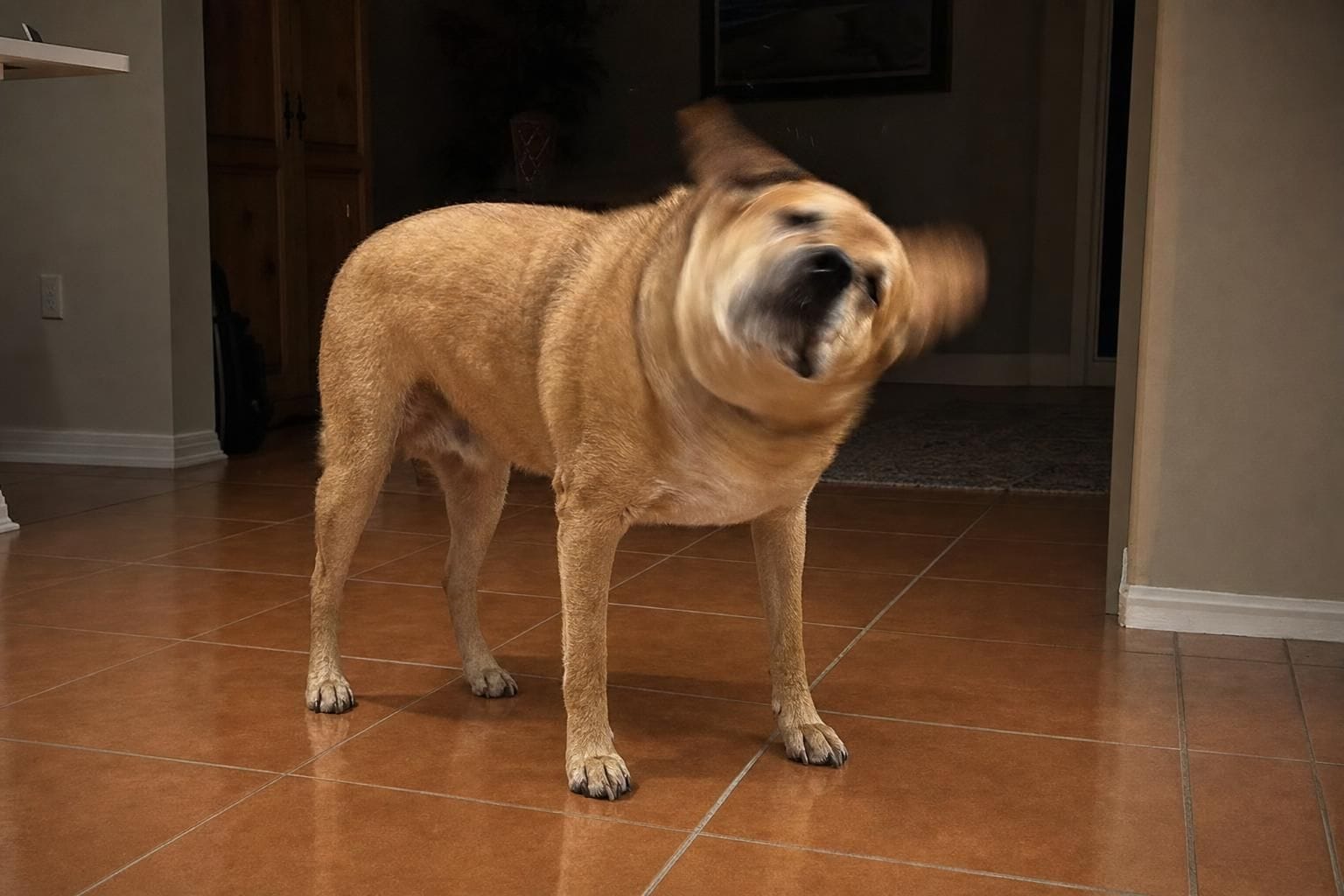
You know the sound. The back leg going against the floor at two in the morning, over and over, and then the licking, and then the shaking, and then it starts again. You have tried the oatmeal shampoo. You have tried switching to grain-free food. You have given Benadryl, probably at a dose someone on Facebook recommended.
And the dog is still scratching.
August is Itchy Pet Awareness Month, which is a slightly funny thing to observe in Palm Beach County, because down here every month is itchy pet month. We see more skin cases than anything else. So here is the honest version of what is going on, why the things you tried did not work, and what actually settles it down.
There Is No Allergy Season Here
In most of the country, an allergic dog gets a break. Frost comes, the pollen drops out of the air, the fleas die back, and the dog stops scratching for four or five months. Owners get a reset. Vets get a reset.
South Florida never freezes. Things grow and bloom and pollinate all twelve months, and the humidity stays high enough that yeast and bacteria are happy on skin year-round. Fleas do not have an off-season either. They just keep going.
What that means practically is that an allergic pet in Palm Beach County never gets to reset. The itch does not build up and then release. It accumulates. And a pet who is mildly itchy in February and mildly itchy in June and mildly itchy in October ends up with skin that has been inflamed and traumatized without a break for years.
That is why so many of the skin cases we see are not simple anymore by the time we get to them. The original allergy is still there underneath, but there is now an infection on top of it, and sometimes an ear infection on top of that, and the whole thing has to be unwound in order.
Five Things Make a Pet Itch. A Bath Fixes About Zero of Them.
This is the part most owners have never had explained. Itching is a symptom, not a diagnosis. Saying a dog is itchy is like saying a person has a headache. Fine, but from what?
1. Fleas, and it is fleas more often than anyone wants to hear
Flea allergy dermatitis is the most common skin disease in dogs across the southern United States, according to the Merck Veterinary Manual. Not one of the most common. The most common.
Here is the part that trips people up. An allergic pet is not reacting to a flea infestation. They are reacting to flea saliva, and it takes very little of it. A pet can react within fifteen minutes of a bite, or the reaction can show up a day or two later, which makes it nearly impossible for an owner to connect cause and effect.
And this is the one we repeat constantly: a severely flea-allergic animal, cats especially, can look completely flea-free. They groom so obsessively that they remove the evidence. So “I checked, there are no fleas” is not the same as “there are no fleas.” We have seen plenty of spotless cats with textbook flea allergy.
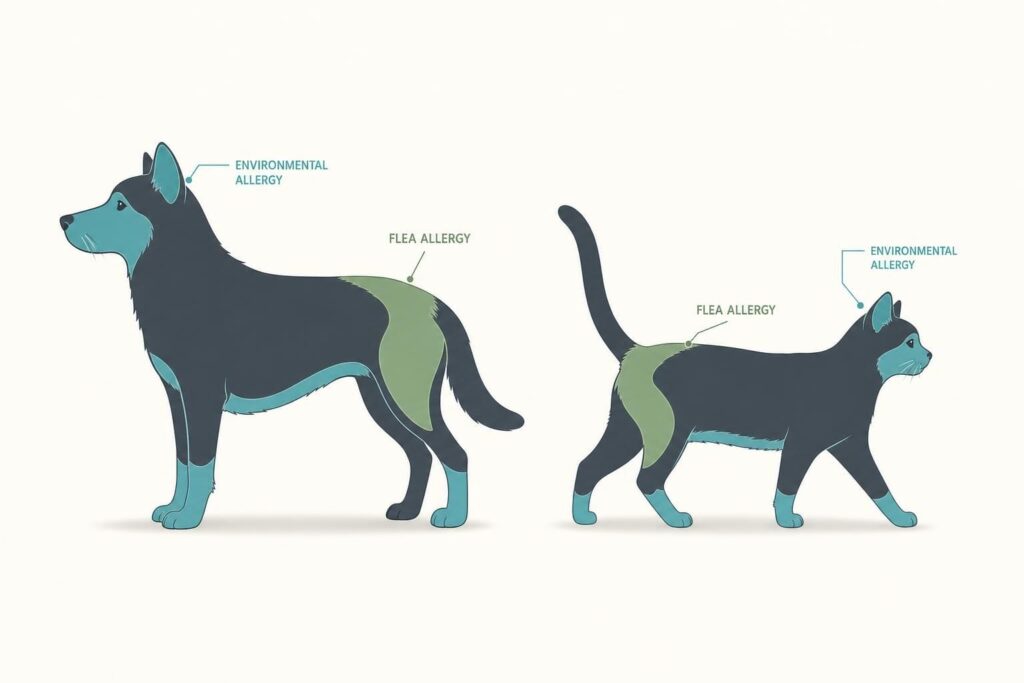
Flea allergy in dogs concentrates on the back half of the body. The lower back, the base of the tail, the backs of the thighs. In cats it shows up on the back, tailhead, backs of the thighs, the groin, and sometimes the head and neck.
2. Environmental allergy, which is the one everybody guesses first
Atopic dermatitis is a genetic tendency to react to things in the environment: pollens, grasses, molds, dust mites. Cornell’s Riney Canine Health Center estimates it affects as much as 10 to 15 percent of the dog population, and it usually announces itself early, somewhere between six months and three years old.
Certain breeds are set up for it: Labradors, Golden Retrievers, West Highland White Terriers, Bulldogs, Boston Terriers, Boxers, Pit Bulls, Shar Peis, Shih Tzus, Weimaraners. Mixed breeds get it too.
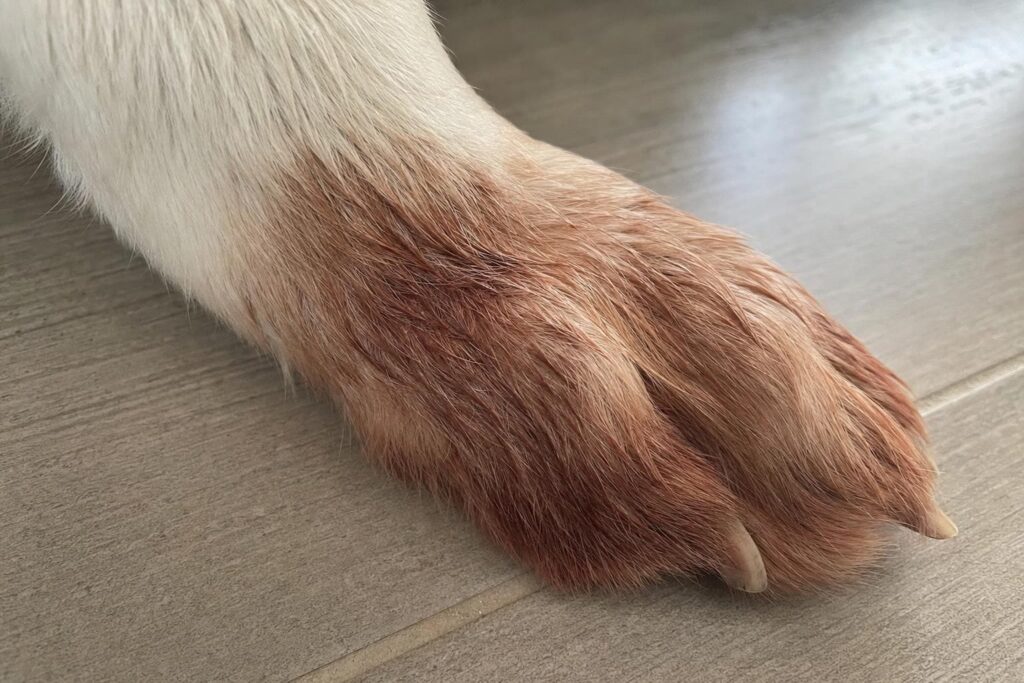
The pattern is different from fleas. Atopy goes for the face, the feet, the belly, the armpits, and the ears. If your dog licks their front feet until the fur turns rusty brown, that is saliva staining, and it is one of the most reliable tells there is. Recurring ear infections in a dog who is otherwise healthy are very often allergy wearing a different hat.
3. Food allergy, which is real but oversold
Food allergy exists. It is just nowhere near as common as the pet food aisle would suggest. Among dogs who come in specifically because they are itchy, roughly 18 percent turn out to have a food allergy, per Today’s Veterinary Practice. That number climbs to about 29 percent in dogs who already have environmental allergies, which tells you something important: a lot of pets have both.
More on why the food trial almost never gets done correctly further down.
4. Secondary infection, which is usually what is actually hurting
Here is what happens. The pet has an allergy. The allergy makes them itch. The scratching and licking breaks the skin barrier. Bacteria and yeast that live on everybody’s skin normally now have an opening, and in this climate they take it.
Now you have a pet with an allergy and a skin infection, and the infection itches more than the allergy did. This is why owners so often say the problem “came out of nowhere and got bad fast.” It did not come out of nowhere. It crossed a line.
You cannot bathe this away and you cannot antihistamine it away. It needs to be identified and treated directly, and the underlying allergy has to be handled at the same time or it just comes back.
5. Everything that looks like allergy and is not
Mites, including sarcoptic mange, which is intensely itchy and contagious. Demodex. Ringworm, which is a fungus and not a worm. Thyroid disease and other hormonal conditions that wreck the coat and skin. In older pets, occasionally something more serious.
These matter because the treatment for an allergy will do nothing for a mite, and some allergy treatments will make a mange case dramatically worse. Guessing has a cost here.
Why the Oatmeal Bath Isn’t Working
Nothing wrong with an oatmeal bath. It is soothing. It rinses off surface allergens. If your pet has mild seasonal itch, it might be enough.
But a bath does not kill fleas in the carpet, it does not treat a skin infection, it does not change what the immune system is doing, and it does not touch a food allergy. It treats how the skin feels for a few hours. Which is why owners get that maddening pattern where the pet seems better the night of the bath and is right back at it by Wednesday.
If you are bathing weekly and nothing is holding, that is not a sign to bathe more often. That is a sign there is something underneath that has not been diagnosed.
The Over-the-Counter Mistake That Puts Pets in the Emergency Room
We need to be blunt about this one, because it comes up constantly and the consequences are severe.
Do not give your pet human anti-inflammatories. Not ibuprofen, not naproxen, not aspirin, and never acetaminophen. Cats are exquisitely sensitive to acetaminophen and a single regular-strength tablet can kill one. Dogs are not safe with these either, and the damage tends to be to the kidneys and the stomach lining, which you will not see happening until it is advanced.
Steroid creams from the medicine cabinet are also a bad idea, mostly because pets lick them off, and because if the actual problem is mange or ringworm you have just made it worse.
Benadryl is a different story. It is generally safe at an appropriate dose, which is worth a phone call to get right for your pet’s weight. It is just frequently not very effective for canine environmental allergy. Safe and useless is better than dangerous, but it is still not a plan.
If your pet has swallowed a human medication, that is an emergency and it is time sensitive. Call us during business hours at (561) 493-3860, and outside our hours go straight to a 24 hour emergency hospital. Veterinary Emergency Group in Boynton Beach is at (561) 752-3232, and Palm Beach Veterinary Specialists in West Palm Beach is at (561) 434-5700. We do not provide after hours emergency service, so please do not wait for us to open.
What an Actual Skin Workup Looks Like
The good news is that most of the diagnostic work for an itchy pet is not high tech. It is careful, and it can happen on your living room floor.
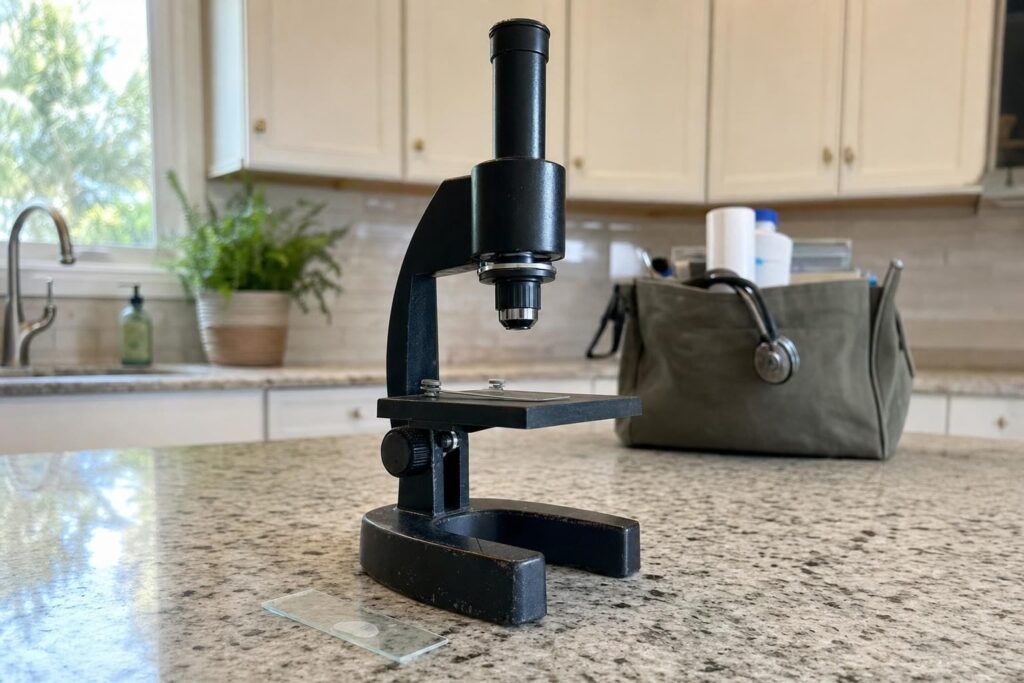
A real skin evaluation means looking at the distribution of the lesions, because as noted above, where it itches narrows the list fast. It means a flea comb, done properly, over the areas fleas actually favor. It means skin cytology, which is pressing a slide against the skin and looking at it under a microscope to see whether there are bacteria or yeast and which one. It means a skin scrape if mites are on the table, and an ear swab if the ears are involved, because ear infections are frequently the same disease as the skin infection and need the same thinking.
Bloodwork comes in when we are worried about a hormonal cause, which is more common in a middle aged or older pet whose skin has gone bad relatively suddenly.
All of that happens in your home. Our mobile veterinary service carries the microscope and the lab supplies, and for the itchy pet specifically the house call has a real diagnostic advantage: we get to see the environment. The yard, the grass, the carpet, where the pet sleeps, whether there is another animal in the house who is not on flea prevention. That context is genuinely useful and you do not get it in an exam room.
Cats Get All of This Too, and Nobody Notices
Cats are the most under-diagnosed itchy patients there are, because a cat does not sit in the living room and scratch dramatically. A cat goes somewhere private and grooms.
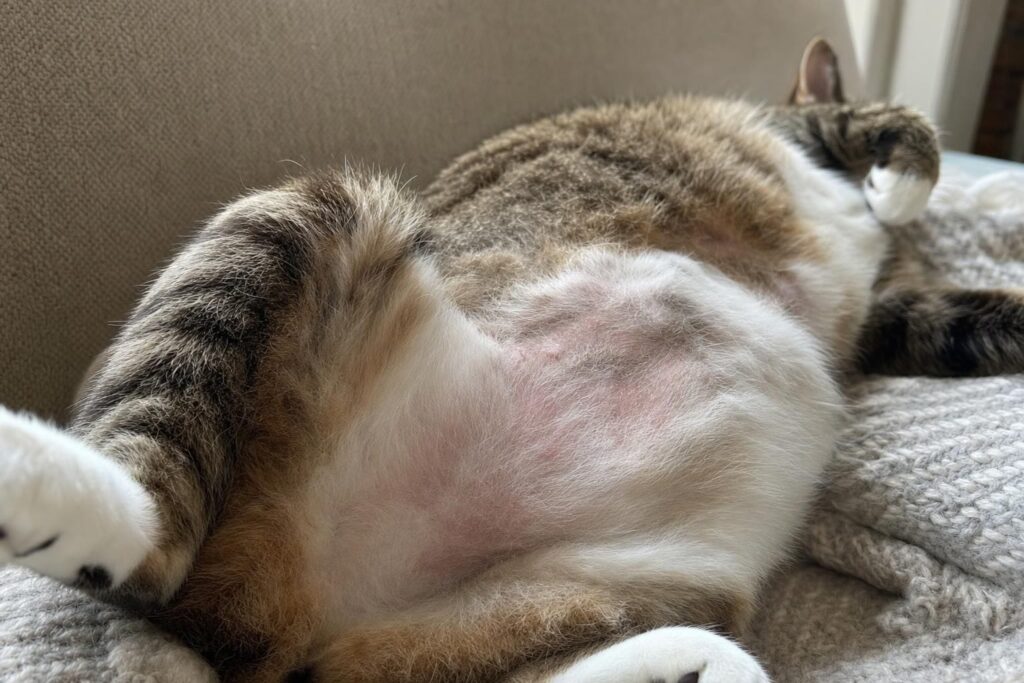
What you see instead is hair that seems shorter on the belly. A bald stripe on the inside of a back leg. Scabs along the spine or around the neck that you find while petting them. Hairballs more often than usual, because they are swallowing all that fur. Some owners think their cat is just fastidious.
Then there is the other problem, which is that getting a cat into a carrier and into a car to investigate a symptom this subtle is a hard sell for most people. So it waits. And it gets worse. This is the single best argument for a house call for a cat, and it is why in-home wellness exams catch things in cats that would otherwise go years unaddressed.
The Food Trial Almost Nobody Finishes
If food allergy is genuinely on the table, there is exactly one way to find out, and it is not a blood test. Blood, saliva, and hair tests marketed for food allergy do not hold up. Studies have repeatedly shown they are unreliable, mostly because they throw false positives, and owners end up eliminating six ingredients that were never the problem.
The real test is an elimination diet trial. One protein and one carbohydrate the pet has not had before, or a hydrolyzed prescription diet, and nothing else. Today’s Veterinary Practice puts the timeline at eight weeks for the trial to be better than 90 percent sensitive. Five or six weeks gets you around 80 percent. Shorter than that and you have learned nothing.
Then, and this is the step everyone skips, you put the old food back. If the itch returns within one to two weeks, which it does in about 90 percent of true cases, you have your answer.
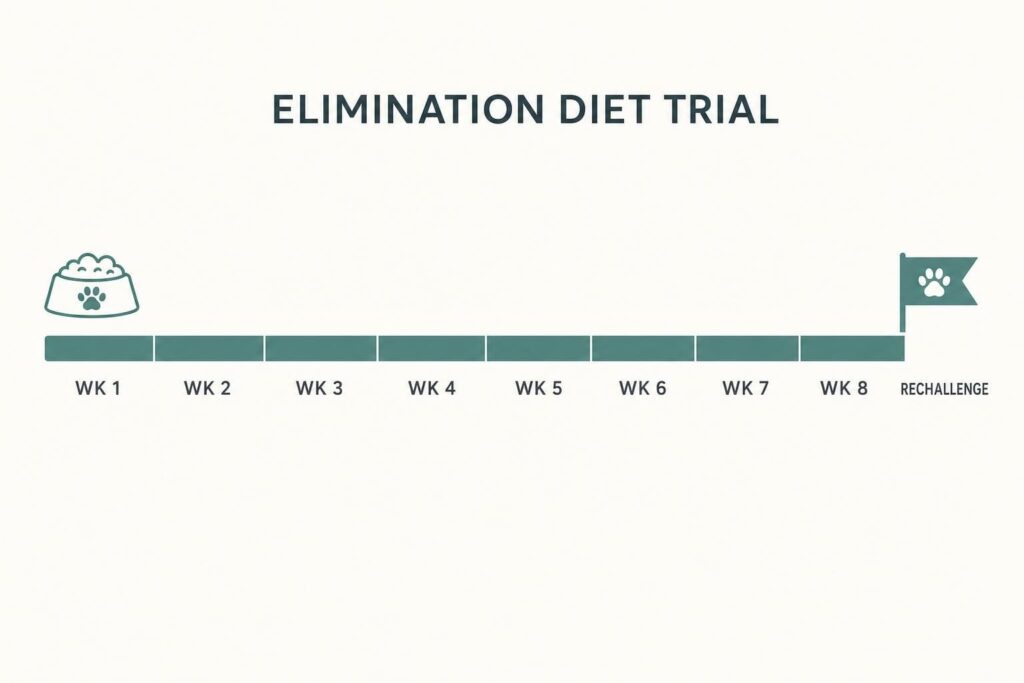
Here is why these fail. Not because the science is shaky, but because a food trial is genuinely hard to run in a real house. The things that void it:
- A little cheese to hide a pill
- Pill pockets, which are food
- Flavored heartworm or flea preventives, which are also food
- Dental chews and treats that someone in the house forgot were treats
- The other dog’s bowl, in a multi pet household, which is the most common failure of all
- Kids and neighbors and anyone who thinks one bite does not count
Before you start one, talk it through with us. Half of running a successful food trial is planning around your actual household, and if you are going to need a non flavored preventive for those eight weeks, that is something to sort out in advance rather than in week three. Our pharmacy service can get the right formulations lined up before you begin.
What Treatment Actually Looks Like Now
Allergy management has improved a great deal, and it is worth knowing that the options are no longer just steroids.
Cornell lists the current toolkit: topical therapy including medicated shampoos and wipes, oral medications including corticosteroids, cyclosporine, oclacitinib, and antihistamines, injectable monoclonal antibody therapy, allergen-specific immunotherapy after testing, and rigorous flea control underpinning all of it.
Which of those is right depends entirely on what is actually wrong, which is the whole point of doing the workup first. A dog with a yeast infection on top of an environmental allergy needs both handled. A cat with flea allergy needs the household treated, not just the cat.
What we will not do is put a pet on a long steroid course and call it a plan. It works, and it feels like a miracle for about three weeks, and then you are managing steroid side effects on top of a skin disease you still have not diagnosed.
When It Needs More Than a House Call
Most skin cases are handled entirely in the home. Occasionally they are not. A deep infection that needs sedation to clean and debride properly, a mass that needs to come off and go to pathology, an ear that has been infected so long it needs to be flushed under anesthesia.
When that happens, it stays in house. The workup happens at your home, the procedure happens at our own surgical facility in Lantana, and the recheck happens back at your house. We are not handing your pet’s chart to an outside surgeon at an unaffiliated clinic and hoping the history travels with it. The practice that diagnosed the problem is the practice that treats it and follows it.
For an itchy pet that continuity matters more than it sounds like it should, because skin disease is managed over months. Whoever is adjusting the plan needs to remember what has already been tried.
Where We Come
We provide house calls throughout Palm Beach County. Northern county including Jupiter, Tequesta, North Palm Beach, Palm Beach Gardens, Singer Island, and Juno Beach. Central county including West Palm Beach, Lake Worth, Lake Worth Beach, Palm Beach, Atlantis, Greenacres, Lantana, Manalapan, Hypoluxo, Briny Breezes, and Golf. Western county including Loxahatchee, Royal Palm Beach, Wellington, and Westlake. Southern county including Boca Raton, Delray Beach, Boynton Beach, Gulf Stream, and Highland Beach.
Full details are on our locations page.
What Our Clients Say
“Good and useful service. Understanding of our dog’s particular temperament and inability to get into a car (or be lifted) we had to have someone come to us. Very kind veterinarian and assistant. This was just for a stubborn ear infection, so they provided the appropriate treatment. They were communicative and on time for our meeting giving us about a 1.5 hour window when they would be coming.” Jeanette Jeffcott, Google review ]
Frequently Asked Questions
Why is my dog itching when I do not see any fleas?
Because a flea-allergic pet does not need a flea infestation to react, only flea saliva, and grooming removes the evidence. Cats especially can be completely flea-free to the eye and still have textbook flea allergy. It is also entirely possible the itch is environmental allergy, a skin infection, or mites instead.
Do pets in Florida get a break from allergies in winter?
Not really. There is no hard freeze in South Florida, so plants pollinate year-round and fleas never die back seasonally. That is why allergic pets here tend to accumulate skin damage instead of getting the annual reset that pets in colder climates get.
Can I give my dog Benadryl for itching?
It is generally safe at the right dose for your pet’s weight, which is worth a quick phone call to confirm. It is just often not very effective for canine environmental allergy. What you must not give is ibuprofen, naproxen, aspirin, or acetaminophen. Acetaminophen can kill a cat at a single regular-strength tablet.
Will switching to grain-free food stop the itching?
Usually not. Food allergy accounts for roughly 18 percent of dogs who present because they are itchy, and when it is the cause the trigger is far more often a protein than a grain. Switching brands casually also makes a proper diagnosis harder later, because it muddies the food history.
How long does an elimination diet trial take?
Eight weeks of strict feeding for the best accuracy, then a rechallenge with the original food. Five or six weeks gets you a less reliable answer. The trial is voided by treats, pill pockets, flavored preventives, and the other pet’s bowl, so it needs planning before you start.
Can you diagnose skin problems during a house call?
Yes, for most cases. We bring the microscope and lab supplies for skin cytology, skin scrapes, ear swabs, flea combing, and bloodwork. Seeing your pet’s actual environment is a genuine advantage for skin cases. If something needs sedation or surgery, that is done at our own Lantana facility.
My cat is not scratching but has bald patches. Is that the same problem?
Very possibly. Cats itch by overgrooming rather than scratching, so the sign is missing fur rather than visible scratching. Thinning on the belly, a bald stripe inside a back leg, scabs along the spine, or more hairballs than usual are all worth an exam.
Do you treat skin emergencies after hours?
No. We offer urgent and same-day appointments during business hours, Monday through Friday, 8:00 AM to 6:00 PM. For anything after hours, go to a 24 hour emergency hospital. Veterinary Emergency Group Boynton Beach is at (561) 752-3232 and Palm Beach Veterinary Specialists is at (561) 434-5700.
What to Do This Week
Three things, and the first two take about ten minutes.
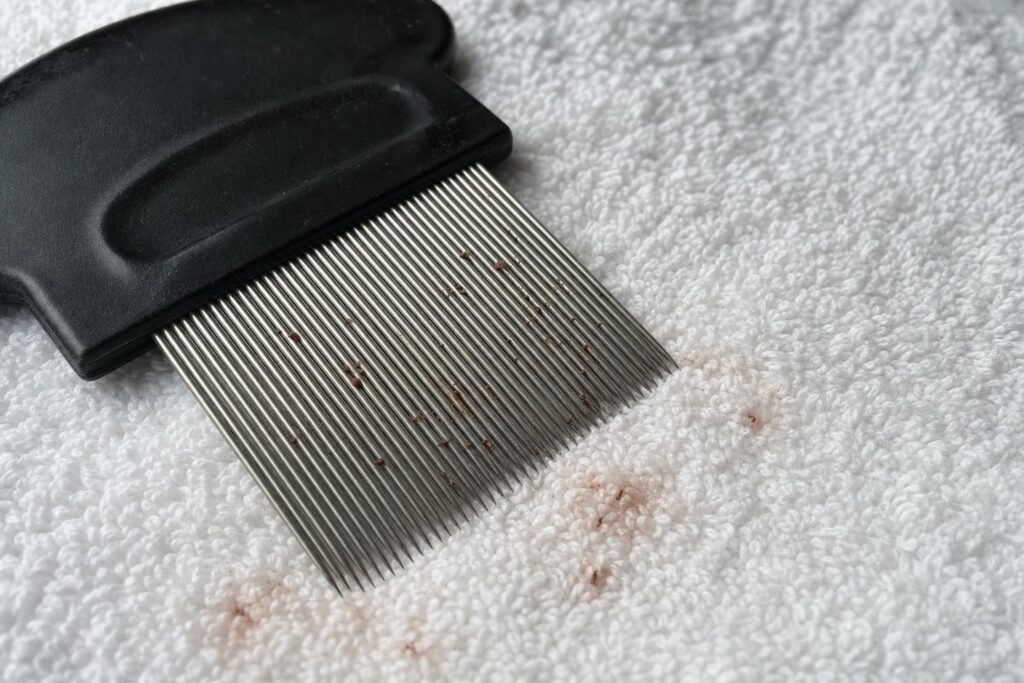
Run the flea comb test. Damp white towel, comb the lower back and tail base, look for black specks, smear them. Rust red means digested blood, which means fleas, regardless of what you have or have not seen.
Check every animal in the house for current flea prevention, not just the itchy one. One untreated cat keeps a household infested and it is the reason a lot of flea allergy cases never resolve.
Then take thirty seconds of video of the scratching or licking. Pets are frustratingly well behaved during appointments and the video is often more useful than what we see in the moment.
Book a Skin Evaluation
If your pet has been itching for more than a few weeks, or has had more than one ear infection this year, it is worth a proper look rather than another bottle of shampoo.
Call (561) 493-3860 or email [email protected]. We are open Monday through Friday, 8:00 AM to 6:00 PM, and we come to you anywhere in Palm Beach County. Multi-pet households can have everyone seen in the same visit, which for a flea allergy case is exactly what needs to happen anyway.
Related Reading